How Trading Apps Handle 1 Million+ Concurrent WebSocket Connections
(Inspired by Zerodha, Upstox, Groww, Robinhood, TD Ameritrade)
Introduction
Modern trading platforms like Zerodha, Upstox, Groww, Robinhood, etc., have one major technical challenge:
How do you stream real-time prices, order book depth, and trade ticks to millions of users simultaneously — with sub-100ms latency and zero downtime?
This is one of the toughest engineering problems in FinTech because market data arrives fast, unpredictably, and at massive scale.
This blog breaks down how real trading apps handle 1M+ concurrent WebSocket connections while staying real-time, consistent, and cost-efficient.
Understanding the Scale
A typical day in Indian markets:
- 3–5 million simultaneous retail traders online
- Millions of WebSocket connections to broker apps
- Price updates 5–50 times per second
- NSE & BSE depth updates every 10–50ms
- 10,000+ symbols streaming concurrently
This is real high-throughput + low-latency engineering.
High-Level Architecture Overview
A trading app’s real-time architecture looks like this:
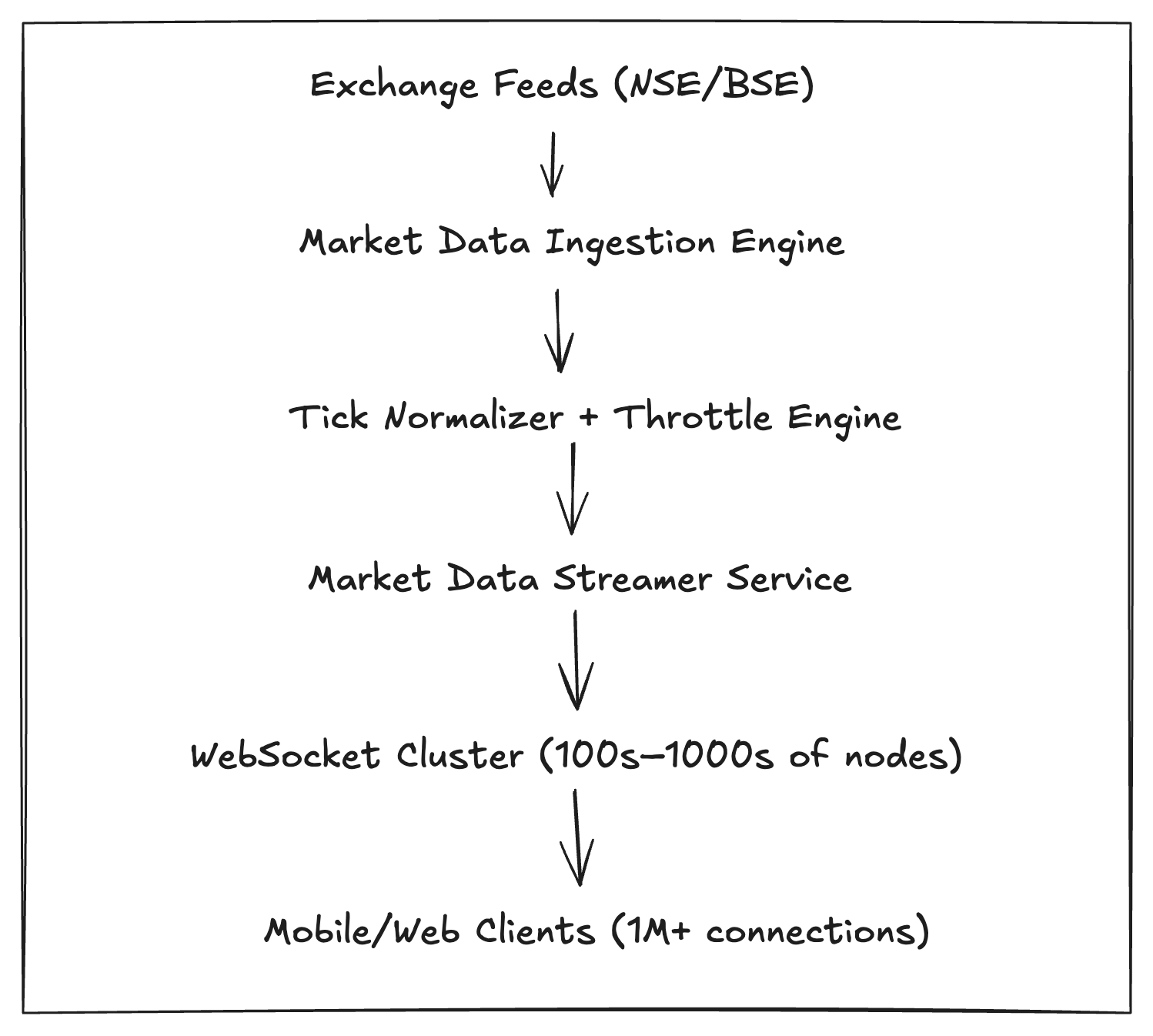
Let’s break it down.
1. Market Data Ingestion Layer
Trading apps receive raw market feeds from exchanges:
- TBT (Tick-by-Tick) feed
- Depth feed
- Trade feed
- Index feed
- Option chain feed
These come in binary formats via leased lines.
To process them, firms use:
- C++ or Rust for ultra-low-latency ingestion
- RDMA or zero-copy sockets
- Folly, Boost ASIO, or custom TCP frameworks
Latency budget here is around 5ms.
2. Tick Normalizer + Broadcaster
Since exchanges send raw binary messages, brokers must:
- Convert them to JSON/Protobuf
- Merge depth + trade + LTP updates
- Remove redundant ticks
- Apply throttling (e.g., send 10 updates/sec per symbol)
- Distribute data to Kafka/Pulsar/Redis
Tools used:
- Kafka (high throughput)
- Redis Streams (low latency)
- NATS (ultra-fast messaging)
- Aerospike (if storing short-term tick data)
Throughput: millions of ticks per second
3. WebSocket Delivery Architecture
This is the core part.
Why WebSockets?
- Bidirectional communication
- Low latency
- Persistent connections
- Lightweight frames
- Perfect for real-time apps
More scalable than REST, less heavy than MQTT.
4. WebSocket Cluster (Horizontal Scaling)
To handle 1M+ concurrent connections, brokers deploy large clusters:
- 100–500 WebSocket servers
- Each handling 10,000–40,000 connections
- Load balancers route clients to least-loaded nodes
Typical technology stack:
| Layer | Tools |
|---|---|
| Load Balancer | NGINX, Envoy, HAProxy, AWS ALB/NLB |
| WebSocket Server | Go, Node.js, Elixir/Phoenix, Java Netty, C++ |
| Pub/Sub | Redis, Kafka, NATS, Pulsar |
| Routing | Consistent Hashing, Service Mesh |
Companies like Zerodha use Go and Redis, while Upstox and Robinhood heavily use Kafka.
5. Connection Distribution Strategy
To avoid overloading a single node:
Technique 1: Consistent Hashing
Users subscribe to symbols (e.g., NIFTY, RELIANCE). Same symbol streams are always pushed from the same few nodes.
Technique 2: Sharded Streams
Symbols are partitioned into shards:
Shard 1 → Node A
Shard 2 → Node B
Shard 3 → Node C
Technique 3: Sticky Sessions
Load balancer keeps the same client on the same WebSocket server.
6. Backpressure & Throttling
If a user has a slow network, you cannot push 50 ticks/second.
Trading systems use:
Drop old messages (send only the latest)
Because only latest price matters.
Throttle updates
Send only 5–10 messages/second.
Avoid queue buildup per-client
If queue grows, disconnect the client (industry standard).
7. In-Memory Caching for Ticks
To achieve sub-10ms fan-out latency, brokers use in-memory stores:
- Redis
- Hazelcast
- Memcached
- Aerospike
They maintain:
- Latest price
- OHLC
- Volume
- Order book depth
- Index metadata
All updated in real-time via message streams.
8. High Availability & Fault Tolerance
Trading platforms use:
Multi-zone WebSocket clusters
One AZ failing should not drop 500,000 users.
Hot standby nodes
Auto-join cluster when load increases.
Message replay using Kafka
If WebSocket node crashes, it reconnects to Kafka and resumes streaming instantly.
Health-based routing
Faulty node = removed by LB.
9. Handling Market Open Explosion (The 9:15 AM Spike)
At 9:15 AM, traffic increases 20x within 5 seconds.
Techniques:
- Pre-warm WebSocket nodes
- Autoscale via CPU + connection count
- Preload symbols
- Throttle depth updates
- Use edge caching/CDN for static Web data
10. Client-Side Architecture (Mobile/Web)
On mobile:
- WebSocket reconnect strategy
- Local price cache
- Delta compression
- Adaptive throttling
- Fallback to REST if socket drops
On web:
- Shared worker for websockets
- Backpressure logic
- Efficient DOM diffing
11. Cost Optimization at Scale
Running 200 WebSocket servers costs a lot.
Brokers reduce cost using:
- Bare-metal servers (instead of cloud)
- Go or Elixir (less CPU/memory per connection)
- Zero-copy network IO
- Dedicated NICs
- Low GC pressure runtimes
Zerodha and Upstox famously use co-located servers near exchanges for speed + cost.
Conclusion
Handling 1 million+ concurrent WebSocket connections is one of the hardest FinTech engineering problems.
It requires:
- Ultra-fast ingestion
- Real-time stream processing
- Horizontally scalable WebSocket clusters
- Smart sharding
- Aggressive throttling
- Failover-ready design
- Low-latency, in-memory pipelines
- Network optimizations at every layer
This is why only a handful of trading apps in India (Zerodha, Upstox, Groww) have mastered this at scale.
Key Citations
- Scaling Node.js to 1 Million Concurrent WebSocket Clients
- How to Scale WebSockets for High-Concurrency Systems
- Stock Market App Development: Real-Time WebSocket Dashboards
- Designing Scalable Trading Apps with Real-Time Market Data APIs
- Challenges of Scaling WebSockets
- Scaling WebSockets to Millions
- WebSockets at Scale - Production Architecture
- Handling 1M WebSocket Connections in Spring Boot
- Best Way to Handle One Million Concurrent Socket Connections
- How to Handle 1M WebSocket Connections (Nginx/HAProxy)